Color coated steel: PPGI and PPGL coil and sheet
Prepainted galvanized and galvalume steel in coil, flat sheet and corrugated roofing sheet — 0.12–2.0 mm thick, Z50–Z275 or AZ30–AZ150 substrate, polyester to PVDF coatings, RAL colours.
What color coated steel is
Color coated steel is carbon steel that has been given a metallic coating and then painted on a continuous coil line. The paint is not decoration. It is the barrier that decides how long a panel survives ultraviolet light, rain and salt, and the metallic coating underneath it decides what happens when that barrier is scratched or cut.
Two designations carry almost every export enquiry. PPGI is prepainted galvanized iron, meaning the paint sits on a hot-dip zinc coating. PPGL is prepainted galvalume, meaning the paint sits on a 55% aluminium-zinc coating. The paint line is identical; the substrate is not, and the substrate is what separates a fifteen-year roof from a thirty-year one.
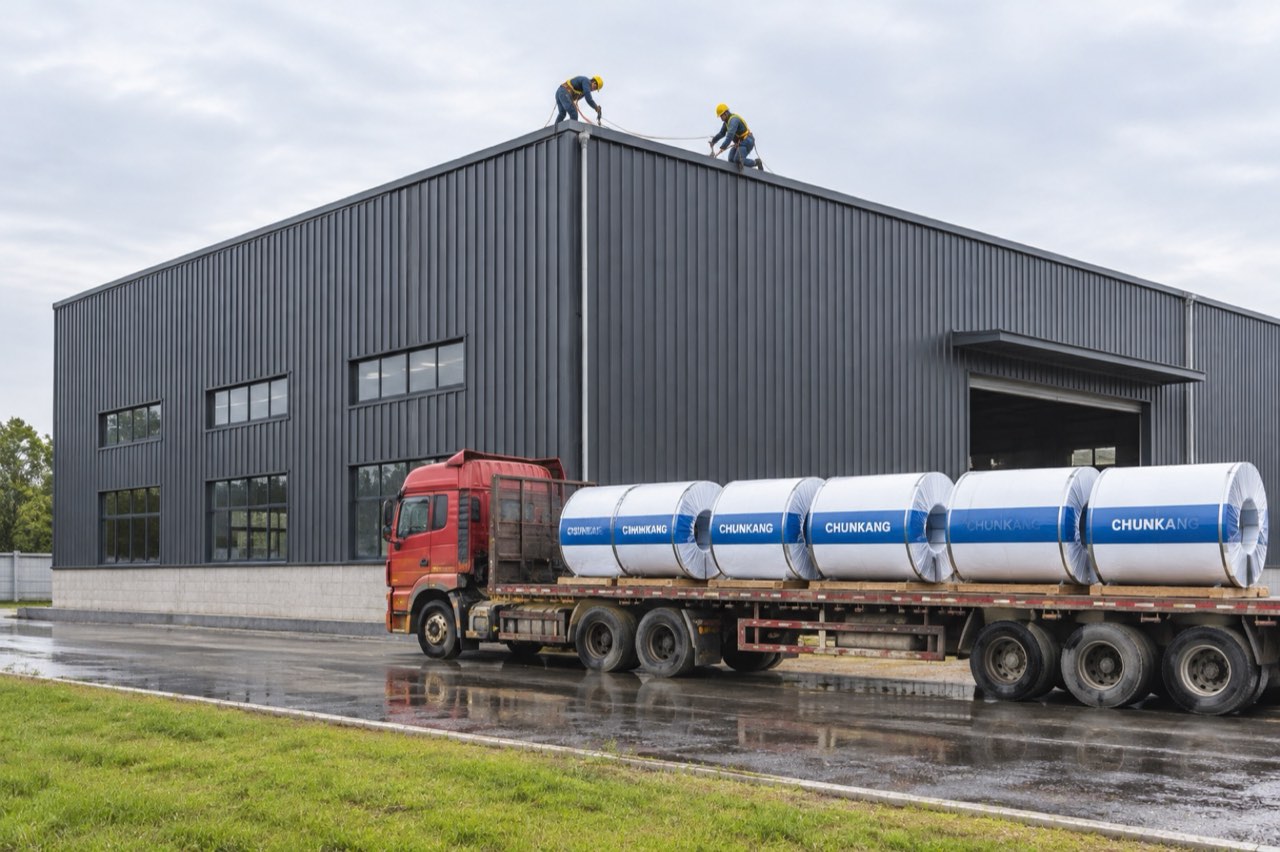
Chunkang supplies color coated steel in three forms: coil for roll-forming and clipping lines, flat sheet cut to length, and corrugated roofing sheet profiled to your cover width. The supply range is 0.12–2.0 mm thick and 600–1,550 mm wide; roofing is normally specified between 0.3 and 0.8 mm, where the panel still forms cleanly and the substrate cost stays sensible.
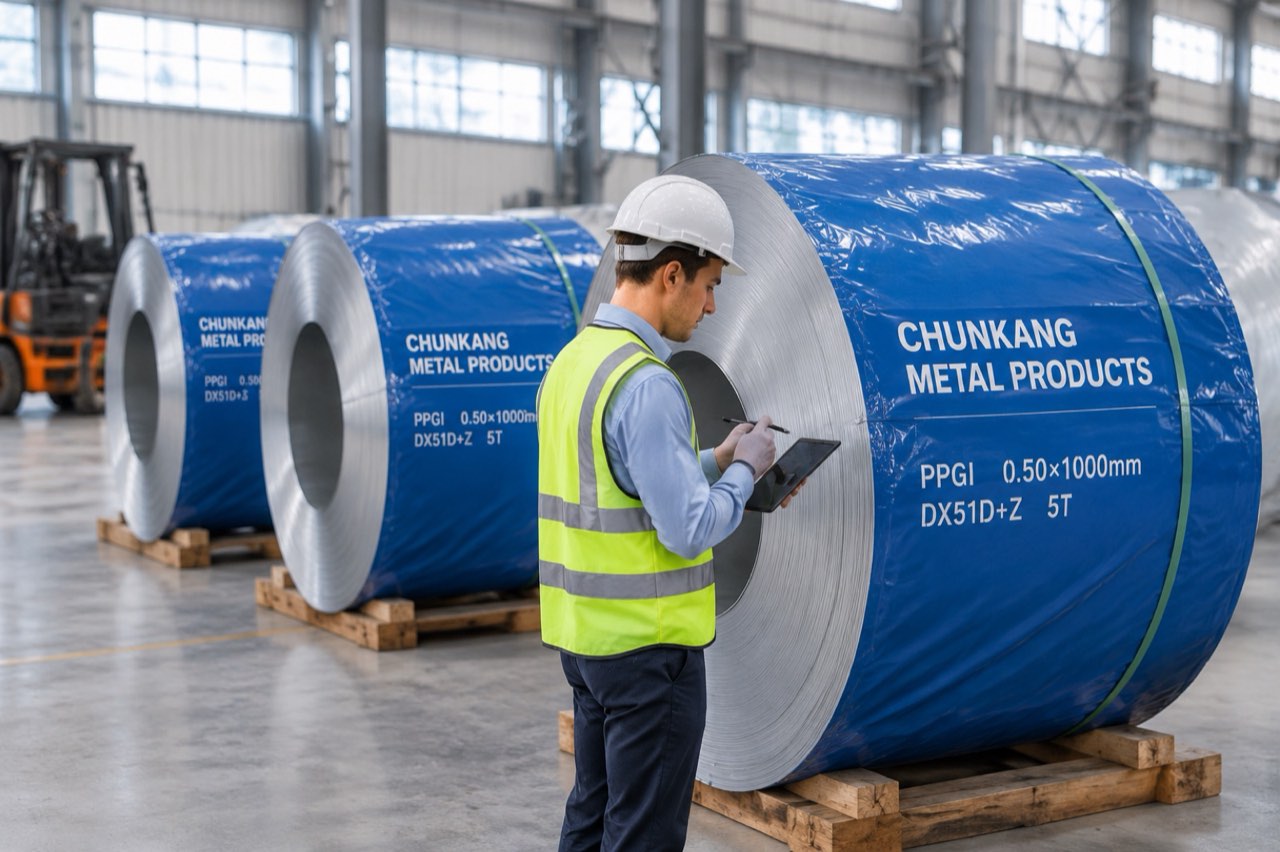
Substrate and metallic coating mass
The metallic coating is the second line of defence and the first thing to specify. Coating mass is written as grams per square metre measured on both faces, so Z275 carries roughly twice the zinc of Z120 and lasts considerably longer outdoors.
| Substrate | Metallic coating | Typical designation | Where it is used |
|---|---|---|---|
| Cold rolled (CR) | None | — | Interior panels and appliances where cut-edge corrosion is not a service condition |
| Hot-dip galvanized (GI) | Zinc | Z50–Z275 | General roofing, wall cladding, ducting, purlins, general fabrication |
| Hot-dip 55% aluminium-zinc (GL) | Aluminium-zinc | AZ30–AZ150 | Coastal, industrial and high-humidity roofing and cladding |
| Electro-galvanized (EG) | Zinc, thin and uniform | EG | Indoor parts, appliance housings, furniture where surface finish matters more than outdoor life |
Practical thresholds used on most projects: zinc at 180 g/m² or above for ordinary outdoor exposure and 275 g/m² for heavy industrial or coastal sites; aluminium-zinc at 100 g/m² or above for exterior cladding and 150 g/m² for severe environments. Below those figures the paint system is being asked to do work the substrate should be doing.
Paint systems and expected outdoor life
The resin decides colour retention and chalk resistance. The figures below are the service lives normally quoted for each system in exterior building use; actual life follows the local atmosphere, the film build and the substrate underneath.
| System | Chemistry | Typical exterior life | Where it is specified |
|---|---|---|---|
| PE | Polyester | 7–8 years | General building panels, cost-driven projects, interior and sheltered use |
| SMP | Silicone-modified polyester | 10–12 years | Roofing, where chalk resistance over time matters more than initial gloss |
| HDP | High-durability polyester | about 15 years | Architectural facades between polyester and fluorocarbon in cost |
| PVDF | Fluorocarbon, normally specified at 70% Kynar 500 resin | 20 years and beyond | High-rise, landmark and aggressively corrosive sites where recolouring is unacceptable |
| Functional | Anti-static, self-cleaning, heat-reflective, anti-bacterial, print | Follows base resin | Clean rooms, food plants, hot climates, wood-grain and stone-print cladding |
Coating structure and film thickness
Film build is written as top coat over back coat. Twenty micrometres of top coat is the usual threshold for outdoor durability; PVDF and high-durability systems are normally specified between 25 and 40 micrometres.
| Structure | Top coat | Back coat | Suits |
|---|---|---|---|
| 2/1 | Primer plus top, 20 µm or more | 5–7 µm | Sandwich panels, where the back face is bonded and never exposed |
| 2/1M | Primer plus top, 20 µm or more | 7–12 µm | Sandwich panels with a visible back face, and light-exposure cladding |
| 2/2 | Primer plus top, 20–40 µm | 12 µm or more | Single-skin roofing and facade, where both faces see weather |
Three product forms
Coil feeds a roll-forming line; flat sheet is cut to length for cladding and flashings; corrugated sheet arrives profiled to a cover width. Each has its own thickness logic and its own packing.
Standards, grades and mechanical values
A prepainted order should name a standard, a grade and a coating mass. Naming only the colour is how projects end up with panels that form differently from the sample.
| Standard | Region | Governs |
|---|---|---|
| JIS G3312 | Japan, widely referenced in Asia | Prepainted hot-dip galvanized steel sheet and strip |
| ASTM A755M | North America | Prepainted hot-dip zinc and aluminium-zinc coated steel sheet, metric |
| EN 10169 | Europe | Continuously organic coated flat steel products for construction |
| GB/T 12754 | China | Prepainted hot-dip coated steel sheet and strip |
Structural grades run from S250GD through S350GD to S550GD, with TS280GD to TS550GD as the alternative designation. Commercial forming grades include DX51D and TDC51D. Yield strength is normally quoted between 250 and 550 MPa and tensile strength between 350 and 600 MPa, with elongation following the grade rather than the coating.
How to write the inquiry
Seven lines avoid almost every dispute that follows a prepainted order: substrate and metallic coating mass (for example GI Z275), steel grade (DX51D or S350GD), thickness and width, coating system and film build, RAL colour, surface finish, and packing orientation. Add the standard if the project is being inspected against one.
Two details are worth stating explicitly because they are misread most often. Thickness excludes paint, so a 0.5 mm order is 0.5 mm of coated steel before painting. And coating mass is a two-face total, so Z275 is 275 g/m² across both surfaces rather than on each one.
Packing for export is normally eye to sky or eye to wall, with moisture barrier paper, steel skin and wood pallet. State the orientation: it changes the lifting gear at the destination port and is not something to settle after the vessel is booked.
Frequently asked questions
What is the difference between PPGI and PPGL?
PPGI is prepainted galvanized iron: the paint sits on a hot-dip zinc coating, designated Z50 to Z275. PPGL is prepainted galvalume: the paint sits on a 55% aluminium-zinc coating, designated AZ30 to AZ150. The paint line is the same; the metallic substrate is different, and that substrate decides corrosion behaviour. Aluminium-zinc resists industrial and coastal atmospheres better, while zinc gives slightly better protection at cut edges in damp alkaline conditions.
Is colour coated thickness measured with or without the paint?
Delivered thickness is base steel plus metallic coating. Paint is not counted, because the cured film carries no structural strength and varies with the coating system. When you specify 0.5 mm PPGI, you are specifying 0.5 mm of zinc-coated steel before painting.
Which substrate should I choose for a roofing project?
For coastal, industrial or high-humidity sites, galvalume (AZ) at 100 g/m² or more is the usual choice. For inland general roofing, galvanized (Z) at 180 g/m² or more performs well and costs less. Above 275 g/m² zinc or 150 g/m² aluminium-zinc you are buying service life in severe environments rather than a general-purpose panel.
Which standards can the material be certified to?
JIS G3312, ASTM A755M, EN 10169 and GB/T 12754 are the four specifications quoted most often for prepainted steel. Each shipment can be released with an EN 10204 3.1 mill certificate traceable to the heat number, so the coating mass and mechanical values on the certificate can be verified against the order.
Can the paint match a specific RAL number?
Standard RAL codes are produced routinely, including the high-volume architectural shades such as RAL 9006, RAL 9005, RAL 7016, RAL 5010 and RAL 9010. Special colours are matched to a physical sample or a RAL reference, with colour control held batch to batch on the same paint system.
Does the paint system change the warranty position?
Yes. Polyester is a general-purpose system, silicone-modified polyester improves chalk resistance on roofs, high-durability polyester extends the same chemistry further, and PVDF fluorocarbon is specified where the facade must hold colour for two decades or more. The film build matters as much as the resin: below 20 micrometres of top coat, outdoor durability falls away regardless of the resin type.
Related material families
The substrate underneath every prepainted panel is bought as its own product: galvanized and galvalume coil, or cold rolled sheet.